

news
September 10, 2026
When choosing a car seat, age should be treated as a general reference—not the only deciding factor. A child’s height, weight, and the manufacturer’s stated limits are more important when determining whether a particular car seat or seating mode is still appropriate.
For example, one 4-year-old may still fit comfortably within the limits of a five-point harness, while another child of the same age may be taller and ready for a different stage.
Understanding car seat height and weight requirements helps parents know when to keep using the current seat, when adjustments may be needed, and when a child is truly ready to move to a booster seat or the vehicle seat belt.
Car seat height and weight requirements refer to the minimum and maximum height and weight ranges for which a child restraint is designed.
You can typically find this information on the car seat label or in the product manual, including:
One important rule is to look at both height and weight, not weight alone. Your child should remain within all applicable limits established by the manufacturer.
For example, if a seat allows a child to use the harness up to 65 lb but the child has already exceeded the maximum harness height, the harness mode should not continue to be used simply because the child is still under the weight limit.

| Stage | What to Check | When to Move to the Next Stage |
| Rear-facing | Car seat height and weight limits | When the child reaches the rear-facing height or weight limit |
| Forward-facing harness | Five-point harness limits | When the child exceeds the harness height or weight limit |
| Booster seat | Booster height and weight requirements | Until the vehicle seat belt fits the child correctly |
| Vehicle seat belt | Proper seat belt fit | When the child passes the seat belt fit test |
There is no single height or weight limit that applies to every car seat. Always follow the limits listed for the specific model your child is using.
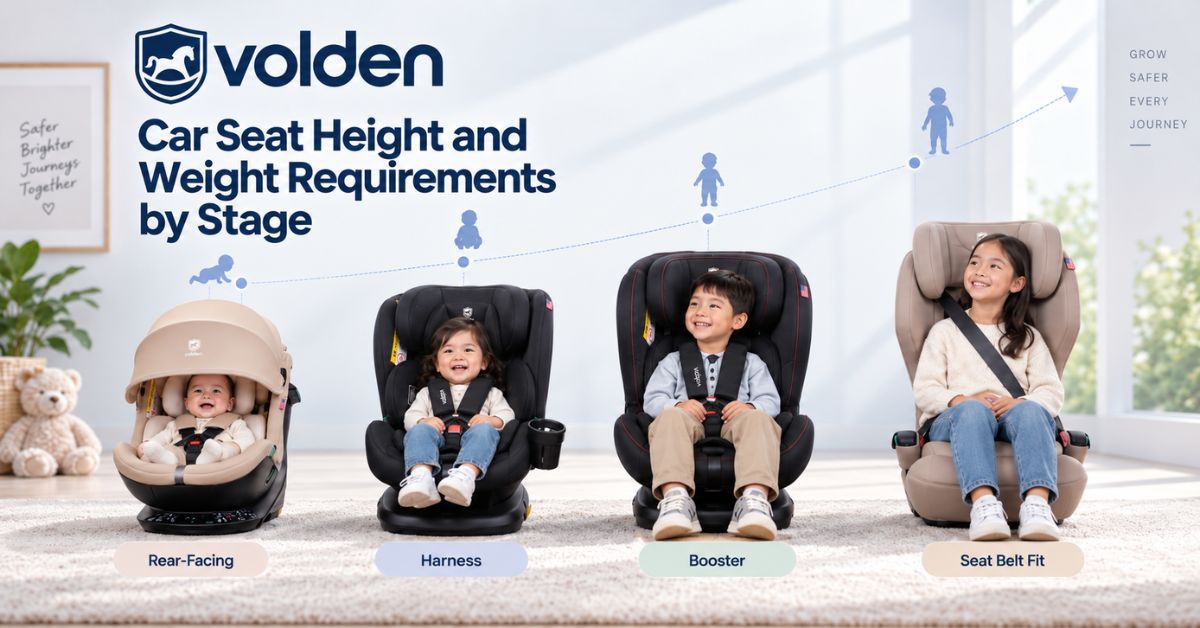
Once a child has outgrown the rear-facing limits of the seat, they may transition to a forward-facing car seat with a harness, provided they meet the manufacturer’s requirements.
At this stage, pay close attention to:
Parents should avoid moving a child to a booster simply because the child has reached the minimum booster age. If the child still fits within the forward-facing harness limits, continuing to use the built-in harness may be the more appropriate option.

A booster seat works differently from a car seat with an integrated five-point harness. Its primary purpose is to raise the child so the vehicle’s three-point seat belt fits properly across the shoulder, chest, hips, and upper thighs.
A child should only move to a booster when they:
High-back boosters can provide additional support for belt positioning and the child’s head and upper body. Backless boosters may be appropriate for older children when the vehicle seat provides adequate head support.
A commonly referenced height is approximately 4 ft 9 in, or about 57 inches, but height alone does not determine whether a child is ready to use the vehicle seat belt without a booster.
The seat belt should fit the child’s body correctly without assistance from a booster.
Parents can use the following five-step seat belt fit test:
If any of these conditions are not met, the child may still need an appropriately sized booster seat.
Parents may focus on age instead of the maximum rear-facing limits of the car seat. The seat’s specific height and weight requirements should guide the transition.
A child may exceed the seat’s maximum height before reaching its maximum weight. Both measurements matter.
A child may meet the minimum age requirement but still not be physically or developmentally ready to remain correctly positioned in a booster throughout the ride.
If the vehicle seat belt still crosses the child’s stomach or neck instead of fitting low across the hips and properly across the shoulder, the child may still benefit from a booster.
Child restraint laws can also vary by state in the U.S. Parents should check the requirements in their state of residence—and any state they may be traveling through—while continuing to follow the car seat manufacturer’s instructions.

The right car seat is not simply one that matches your child’s age. Parents should consider height, weight, seating direction, harness type, fit, and adjustability as the child grows.
When comparing car seats, look for products with clearly stated usage ranges, easy-to-follow instructions, and adjustment options that accommodate different stages of development.
For multi-stage car seats, check the limits for each individual mode rather than relying only on the overall height or weight range listed for the product.
Understanding car seat height and weight requirements can help parents avoid two common problems: moving a child to the next stage too early or continuing to use a seating mode the child has already outgrown.
At Volden, we believe choosing the right car seat begins with understanding how your child grows and making informed decisions at every stage. By checking your child’s height and weight regularly and following the requirements of your specific car seat, you can choose a setup that better supports your family through every journey.